
- Manthan Adhyayan Kendra

Legacy Issues in Energy Transitions
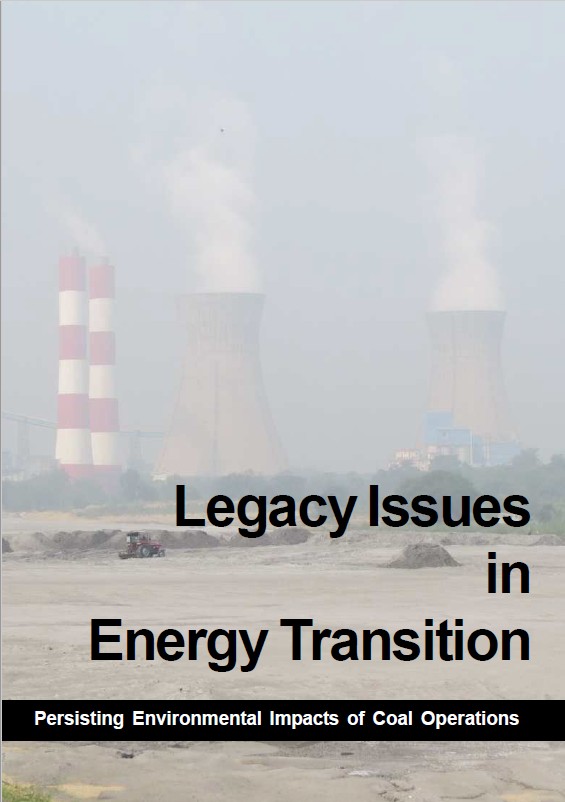
Legacy Issues in Energy Transition: Persisting Environmental Impacts of Coal Operations
Energy transition is talked about a lot currently. At its core is a shift in the energy sources for power generation from coal to non-carbon sources, like solar, wind and others.
Coal, currently the mainstay of our power system, has many serious environmental and social impacts. Unfortunately, a lot of these have remained unaddressed and continue to threaten local ecologies, and livelihoods and health of local communities. If these impacts are not handled, they will end up being a permanent and unwanted legacy of the transition away from coal.
These legacies are of concern for two reasons. First, these legacies continue to have adverse environmental, social and health impacts. Second, given that these legacies are mainly issues that the extant legal framework requires to be addressed, they essentially are physical manifestations of violations of the law.
This report covers in detail the legacies that are likely to be left behind by coal operations including legacy ash, legacies of coal washeries, legacies left behind by coal mines that are at the end of their lives and are planned to be closed, legacies of thermal power plants that will be retired and final the legacy of a mindset that has driven the approach to planning and building of conventional energy infrastructure.
Energy transition can have other legacies – like the fate of workers of power plants and coal mines, or the impacts on local economies as coal-operations wind down. In this report, we focus on the legacies of the environmental impacts of coal-operations, and in particular those that pertain to impacts on water and land.
The report presents several recommendations and urges that the people and communities be kept at the centre of all efforts to address these legacies.
This report is authored by Shripad Dharmadhikary for Vikalp Social Organisation, which has also published it. It is shared here for easy access.
Published July 2026